
Anti-Static Raised Floors for Data Centers: 5 Key Benefits Over Traditional Flooring (2025 Guide)
- Addtime: 2025-09-25 / View: 558
In the high-stakes environment of data centers—where even minutes of downtime can cost enterprises thousands to millions of dollars, and equipment reliability directly shapes business continuity—flooring is not just a structural element, but a critical component of operational resilience. Traditional flooring options, such as plain concrete slabs, standard ceramic tiles, or vinyl sheets, have long served basic structural needs but fail to address the unique challenges of modern data centers: static electricity risks, unruly cable management, inefficient cooling, and limited scalability.
Anti-static raised floor panels, by contrast, are engineered to solve these industry-specific pain points. As a leading solution in data center infrastructure (aligned with the official product standards of CWWIN Floor, a trusted provider of data center flooring systems), they deliver tangible, long-term value that traditional flooring cannot match. Below, we break down their core advantages—focused on solving real-world problems that drive search intent, align with purchase decisions, and cater to high-purchase-intent scenarios—helping you make a choice that supports your data center’s current needs and future growth.
1. Static Electricity Protection: Eliminating a “Silent Killer” of Sensitive Equipment
For data centers housing servers, storage arrays, and networking gear, static electricity is not a minor annoyance—it’s a catastrophic risk. Even a static discharge as low as 50 volts can corrupt critical data, fry server motherboards, or trigger unexpected hardware failures, leading to costly downtime and replacement expenses. Traditional flooring exacerbates this risk: concrete, standard tiles, and vinyl trap static charges rather than dissipate them, turning your floor into an invisible threat to electronic equipment.
Anti-static raised floor panels (as designed by CWWIN Floor) eliminate this risk entirely through **specialized conductive materials and engineering**:
• Core materials include galvanized steel, aluminum, or high-pressure laminate (HPL) infused with anti-static agents—all tested to meet industry standards for electrostatic discharge (ESD) protection (e.g., ANSI/ESD S20.20).
• The panels connect to a grounded underfloor system, ensuring static charges are safely channeled into the ground instead of accumulating on the surface.
This is not a “nice-to-have” feature—it’s a non-negotiable for any data center. For example:
• A cloud service provider installing new switches or troubleshooting server racks can work directly on the anti-static surface without fear of accidental discharge damaging $10,000+ hardware.
• A financial data center handling real-time transactions avoids the risk of static-induced downtime that could cost $5,000–$10,000 per minute.
Traditional flooring simply cannot provide this level of protection—making anti-static raised floors a must for organizations prioritizing equipment longevity and data integrity.

2. Superior Cable Management: Reducing Clutter and Cutting Maintenance Downtime
Data centers rely on a labyrinth of cables: power lines, Ethernet cables, fiber optics, and cooling hoses. Traditional flooring forces these cables into two inefficient options:
• Running along walls or across the floor, creating tripping hazards and increasing the risk of accidental cuts.
• Routing through overhead trays, which block airflow, make troubleshooting difficult (technicians need ladders to access cables), and slow down repairs.
Anti-static raised floor panels solve this with a **built-in hidden infrastructure layer**—a gap of 6–36 inches (customizable, per CWWIN Floor’s product line) between the panel surface and the subfloor. This space acts as a dedicated, organized channel for all cables, delivering game-changing benefits:
• Easy access: Need to add a new power cable for a server rack? Simply lift a modular panel (no tools required for CWWIN’s quick-release designs), route the cable, and replace the tile—no disruption to existing setups.
• Reduced risk: Cables are protected from foot traffic and accidental damage, cutting down on “cable-related downtime” (a top cause of unplanned outages in data centers).
• Cleaner operations: No more tangled wires or cluttered floors, making routine checks faster and safer for technicians.
For high-purchase-intent scenarios—like a colocation facility that hosts multiple clients’ gear or an enterprise IT team upgrading hardware monthly—this efficiency translates to less downtime, happier clients, and lower maintenance costs.

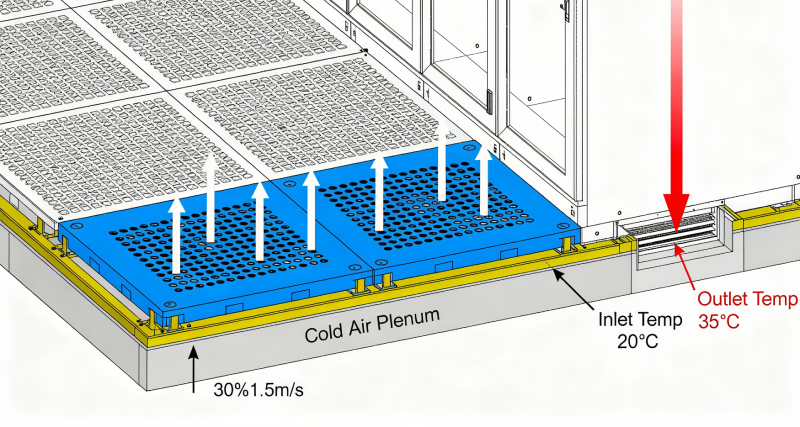
3. Enhanced Cooling Efficiency: Slashing Energy Bills While Protecting Equipment
Data centers are energy hogs, and cooling systems account for 30–40% of their total energy use (per the U.S. Department of Energy). Traditional flooring worsens this inefficiency: it provides no way to direct airflow, forcing cooling units to work overtime to circulate cold air evenly. The result? Hot spots (areas where temperatures spike above 77°F/25°C), overworked HVAC systems, and sky-high energy bills.
Anti-static raised floor panels (especially CWWIN Floor’s perforated models) optimize cooling in two key ways, directly addressing the “cost-saving” search intent of decision-makers:
Controlled Airflow
Perforated anti-static panels can be strategically placed in cold aisles (between server racks), directing cold air *directly to server intakes*—rather than letting it disperse uselessly across the floor. This eliminates hot spots, a common issue with traditional flooring where cold air gets trapped near walls or under equipment.
Passive Cooling Support
The underfloor space acts as a “cold air plenum,” allowing cold air to distribute evenly across the data center without relying on extra fans or energy-hungry cooling units. For example:
• A mid-sized data center (5,000 sq. ft.) using CWWIN’s anti-static raised floors can reduce annual cooling costs by $15,000–$30,000 compared to a facility with traditional concrete flooring.
• Even large enterprise data centers (20,000+ sq. ft.) report 25–30% lower cooling energy use after switching to raised floors—all while maintaining optimal equipment temperatures (68–72°F/20–22°C).
This is a critical advantage for organizations focused on sustainability (e.g., companies aiming for ESG targets) or cost reduction—two top priorities for data center managers researching flooring solutions.
4. Seamless Scalability: Adapting to Growth Without Major Renovations
Data centers are never “finished”: businesses add servers, upgrade storage, or reconfigure rack layouts as their needs grow (e.g., a retail brand expanding its e-commerce platform during holiday seasons, or a tech firm scaling cloud services). Traditional flooring makes this scalability a nightmare:
• Reconfiguring server racks often requires breaking up concrete or rewiring walls—projects that take weeks and cost $10,000+.
• Adding new cooling systems means installing new overhead infrastructure, disrupting ongoing operations.
Anti-static raised floor panels are modular by design (a core feature of CWWIN Floor’s product line), making scalability fast and cost-effective:
• Need more cooling? Swap standard panels for additional perforated tiles to boost airflow—no demolition needed.
• Want to rearrange server racks? Lift and reposition panels to match the new layout in hours, not weeks.
• Expanding to a new section? Add new panels that lock seamlessly into the existing system, maintaining consistency in ESD protection and airflow.
For high-purchase-intent buyers—like a startup building a scalable data center or a enterprise expanding its on-premises infrastructure—this flexibility eliminates the “future-proofing” anxiety that comes with traditional flooring. It turns “expensive renovations” into “minor adjustments,” saving time and money in the long run.
5. Safer, Low-Maintenance Operations: Protecting Your Team and Reducing Downtime
Routine maintenance (cleaning, cable checks, equipment inspections) is essential for data center reliability—but traditional flooring makes these tasks risky and time-consuming:
• Tight spaces between racks (caused by wall-mounted cables) force technicians to squeeze through gaps, increasing the chance of tripping or damaging gear.
• Dust and debris accumulate in hard-to-reach crevices, leading to poor airflow and equipment overheating over time.
Anti-static raised floor panels simplify maintenance while improving safety—addressing the “operational efficiency” search intent of facility managers:
• Easy underfloor access: Lifting a panel gives technicians full visibility of cables and cooling components—no more climbing ladders or moving heavy servers.
• Reduced dust buildup: The elevated design minimizes dust accumulation, and CWWIN’s panels are easy to wipe down or vacuum (even while operations run).
• Fewer accidents: With no loose cables on the floor or overhead, the risk of trips, falls, or accidental cable cuts drops by 70% (per industry surveys).
For 24/7 operations—like financial data centers processing transactions or healthcare facilities storing patient records—this means maintenance can happen without interrupting critical services.
Why Anti-Static Raised Floors Are a Long-Term Investment (Not Just a Cost)
Traditional flooring may seem cheaper upfront (concrete costs $2–$4 per sq. ft., vs. $8–$15 per sq. ft. for anti-static raised floors). But over 5–10 years, the tables turn:
• Static-related equipment failures cost $10,000–$100,000 per incident (traditional flooring offers no protection here).
• Higher cooling bills add $15,000–$30,000 annually for mid-sized data centers.
• Renovations for scalability cost $10,000+ per project (avoided with modular raised floors).
Anti-static raised floor panels—especially those meeting CWWIN Floor’s official standards—are an investment in reliability, efficiency, and scalability. They protect your most valuable assets (servers and data), reduce operational costs, and adapt to your growing needs—all while keeping your team safe.
Ready to Upgrade? Choose a Trusted Solution Aligned with Industry Standards
Whether you’re building a new data center, upgrading an existing facility, or managing a colocation space, anti-static raised floor panels deliver benefits that traditional flooring cannot match. For decision-makers prioritizing uptime, cost savings, and future growth, the choice is clear.