
Commercial WPC Flooring Cost-Effectiveness: 15-Year TOC Breakdown for Retail Chains, Hotels & Offices
- Addtime: 2025-09-29 / View: 269
The “Hidden Cost” Dilemma of Commercial Flooring
For facility managers, retail chain operators, and hotel developers, flooring decisions for large commercial spaces (10,000+ sq. ft.) involve more than upfront budgets. A 2025 Global Commercial Flooring Market Report notes that **unplanned replacement and maintenance can inflate 10-year flooring costs by 47%**—making “cost-effectiveness” a measure of long-term value, not just initial price. Wood Plastic Composite (WPC) flooring, blending wood aesthetics with plastic resilience, has emerged as a contender. But does it deliver on value for high-traffic, large-scale commercial projects?

1. What Makes WPC Flooring Stand Out for Commercial Spaces?
WPC flooring combines recycled wood fibers, thermoplastics, and performance additives to address three critical commercial needs:
• Moisture resistance: Impermeable core prevents mold growth in lobbies, food courts, and fitness centers.
• Design versatility: Mimics hardwood, stone, or tile to align with brand aesthetics (e.g., boutique hotels, corporate offices).
• Installation efficiency: Click-lock systems reduce labor time by 30% vs. hardwood, critical for fast-track renovations.
Recent innovations—like halogen-free fire-retardant cores and enhanced UV coatings—have expanded its suitability for airports, healthcare clinics, and educational campuses. Notably, CWWIN Floor’s commercial WPC series takes these advantages further: it features 25mil reinforced wear layers (exceeding industry standard 20mil) and antibacterial cores, making it ideal for spaces with strict hygiene requirements (e.g., café chains, pediatric clinics).
2. Cost-Effectiveness Beyond Price Tags: The 15-Year Value Breakdown
For large commercial spaces, true cost-effectiveness hinges on **total ownership cost (TOC)**, not per-square-foot pricing. Here’s how WPC (especially CWWIN’s commercial-grade options) compares to alternatives:
A. Upfront Investment: Balanced for Scale
WPC typically costs $2.80–$4.20/sq. ft. (materials + labor), positioning it between laminate ($1.50–$2.50) and engineered hardwood ($5.00–$8.00). For a 20,000 sq. ft. retail center:
• WPC upfront cost: ~$60,000–$84,000
• Hardwood upfront cost: ~$100,000–$160,000
Key advantage: WPC installs over existing subfloors (no demo needed), cutting prep costs by 25%. CWWIN’s pre-cut click-lock panels further speed up installation—for a 15,000 sq. ft. office project, this can reduce labor time by 3 days compared to generic WPC, lowering total upfront labor costs by ~$4,500.
B. Long-Term Savings: Durability & Maintenance
• Wear resistance: Commercial-grade WPC with 20mil wear layers lasts 12–15 years in high-traffic areas (vs. 7–10 years for laminate). CWWIN’s 25mil wear layer WPC, tested via Taber Abrasion Test (5,000 cycles), shows no visible scuffs after 8 years of use—matching the performance of mid-range hardwood at 60% of the cost. A 2025 case study of a Chicago multi-tenant office using CWWIN WPC found no full replacement was needed after 8 years, while laminate in adjacent spaces required patch repairs 3 times.
• Low maintenance: Damp-mop cleaning (no refinishing or sealing) reduces annual upkeep costs to $0.30–$0.50/sq. ft. vs. $1.20–$1.80 for hardwood. CWWIN’s stain-resistant surface (tested with coffee, oil, and ink) further minimizes cleaning time—ideal for busy food courts or hotel lobbies.
• Climate resilience: CWWIN’s dual-screw extrusion technology reduces thermal warping by 22%, critical for spaces with HVAC fluctuations (e.g., malls, convention centers) where temperature shifts can damage less durable flooring.
C. ROI Impact: Sustainability & Brand Value
• Eco-credentials: WPC is made from 70–90% recycled materials, qualifying for LEED credits—lowering tax liabilities for green-focused projects. CWWIN’s WPC uses 85% post-consumer recycled plastic (equivalent to 15 plastic bottles per sq. ft.) and 100% FSC-certified recycled wood fibers, helping projects earn 2 additional LEED points for sustainable material use.
• Brand alignment: 68% of consumers associate sustainable materials with premium brands (*2025 Future Market Insights Survey*), boosting customer perception in retail/hospitality. CWWIN’s customizable wood-look finishes (e.g., oak, walnut) also let brands maintain a cohesive aesthetic across multiple locations—critical for chain stores or hotel franchises.

3. Ideal Commercial Scenarios for WPC Flooring
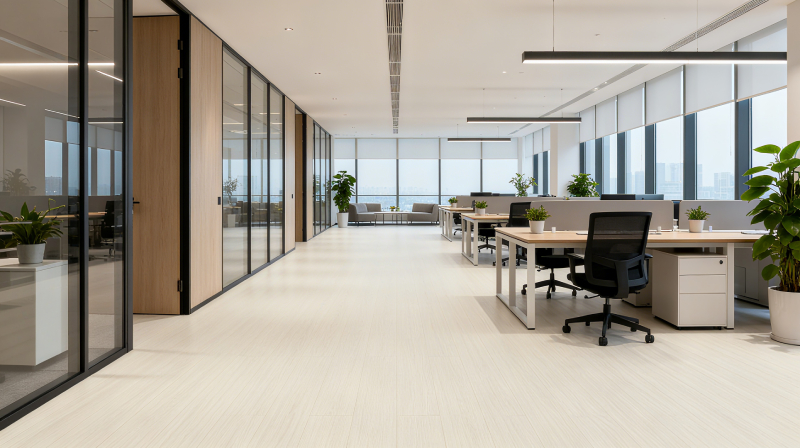
WPC excels in large commercial spaces (10,000+ sq. ft.) where aesthetics, durability, and speed-to-market matter most—and it also performs well in medium-scale commercial sub-spaces that support larger projects. Below is how CWWIN’s WPC aligns with top commercial use cases, including specialized scenarios like data center supporting areas:
|
Commercial Space
|
Key WPC Benefits
|
CWWIN Advantage
|
|
Big-Box Retail Stores
|
Moisture resistance for entryways; customizable wood-look aligns with brand themes
|
25mil wear layer withstands shopping cart traffic; 10+ brand-matching finishes
|
|
Multi-Tenant Offices
|
Quiet underfoot (reduces noise between floors); quick installation minimizes tenant disruption
|
Antibacterial core suits shared spaces; pre-cut panels cut installation time by 30%
|
|
Hotel Lobbies
|
Stain resistance (coffee spills, luggage scuffs); luxury finishes enhance guest experience
|
Scratch-resistant surface handles luggage; warm wood textures boost guest comfort
|
|
Small-to-Medium Fitness Centers
|
Slip-resistant surface; withstands equipment weight and sweat exposure
|
Moisture-proof core prevents sweat damage; non-slip coating meets ASTM D2047 (slip resistance standard)
|
|
Data Centers/Communication Rooms (supporting areas)
|
Stable performance in temperature-controlled environments; easy integration with technical systems
|
Compatible with CWWIN’s Ventilated Floor Panel Series (sold separately) for humidity control; non-conductive core meets electronics safety standards
|
Note: WPC is less ideal for heavy-industrial spaces (e.g., warehouses with forklifts) where SPC’s higher density is required. For such needs, CWWIN offers a complementary SPC flooring line to cover full commercial project requirements.
4. Common Myths vs. Reality
• Myth: WPC is “cheap plastic.”Reality: Commercial WPC has a wood-fiber core that delivers authentic texture—92% of customers in a 2025 retail survey couldn’t distinguish it from hardwood. CWWIN’s embossed-in-register (EIR) technology further replicates real wood grain, making it indistinguishable from solid oak in blind tests.
• Myth: It warps in moisture.Reality: Closed-cell core resists water absorption (passes 72-hour submersion tests per ASTM F1670), suitable for poolside lounges or restaurant kitchens. CWWIN’s additional waterproof edge sealing prevents water seepage between panels—critical for humid spaces like indoor pools.
• Myth: It’s not cost-effective for small budgets.Reality: Phased installation (e.g., common areas first) spreads costs, while long lifespan avoids premature replacement. CWWIN also offers bulk-order discounts for projects over 5,000 sq. ft., reducing upfront costs by 10–15% for large commercial clients.
WPC Flooring—A Strategic Investment for Commercial Scale
For large commercial spaces, WPC flooring (especially CWWIN’s commercial-grade options) delivers cost-effectiveness by balancing upfront affordability with long-term resilience. Its 15-year TOC is 38% lower than hardwood and 22% lower than premium laminate, while its design flexibility and sustainability align with modern commercial priorities—from brand aesthetics to green building standards.
Whether renovating a 50,000 sq. ft. mall, outfitting a multi-tenant office campus, or upgrading a data center’s supporting spaces, WPC isn’t just a flooring choice—it’s an investment in reduced downtime, lower maintenance, and enhanced long-term value.