
High-Traffic SPC Flooring: Why Protective Underlayment Matters
- Addtime: 2025-10-09 / View: 235
High-traffic zones—from residential hallways, kitchens, and entryways to commercial lobbies, retail spaces, and office corridors—face relentless wear: constant foot traffic, dropped items, accidental spills, and even heavy furniture movement. If you’ve chosen SPC (Stone Plastic Composite) vinyl plank flooring for these areas (drawn to its reputation for rigidity, waterproofing, and scratch resistance), a critical question arises: Is a protective underlayment necessary to maximize its performance?
The answer is yes, for nearly all high-traffic scenarios—but the reasoning depends on your subfloor condition, functional needs (like noise control or comfort), and long-term goals for your flooring investment. Below, we break down the technical logic behind underlayment for SPC in busy spaces, address common misconceptions, and align recommendations with real-world use cases—including insights tailored to CWWIN Floor’s SPC product strengths and our exclusive underlayment solutions.
First: Why SPC Excels in High-Traffic Zones (And Where It Needs Support)
CWWIN Floor’s SPC vinyl plank flooring is engineered for durability: its high-density stone-plastic composite core (blended with PVC) resists scratches, dents, and warping, while a UV-enhanced coating extends lifespan and a PVC wear layer repels moisture—all key for busy spaces. But even with these advantages, SPC has inherent limitations that underlayment solves:
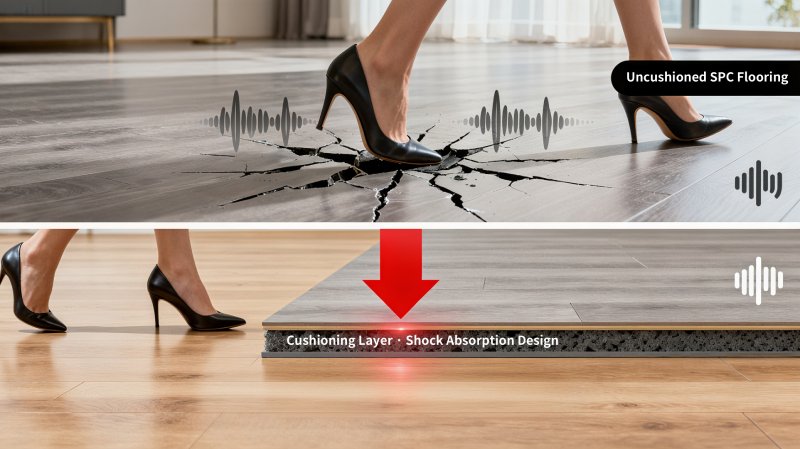
1.Rigidity = limited impact absorption: SPC’s firm core doesn’t cushion heavy foot traffic or dropped objects, which can accelerate wear on the plank’s locking system over time.
2.Sound transmission risks: Thinner than traditional tile or hardwood, SPC can amplify impact noise (e.g., footsteps, rolling chairs) in multi-level homes or commercial buildings—disturbing occupants below.
3.Subfloor dependency: Even the most durable SPC relies on a smooth, stable subfloor. Minor cracks or unevenness in concrete, plywood, or existing flooring can cause planks to shift, gap, or crack under repeated use.
4 Critical Factors to Decide If You Need Underlayment for SPC in High-Traffic Zones
Underlayment isn’t an “add-on”—it’s a strategic investment to protect your SPC and enhance its functionality. Here’s how to assess your needs:
1. Subfloor Type & Condition: The Foundation of Long-Lasting SPC
High-traffic zones magnify subfloor flaws. Underlayment acts as a buffer, ensuring your SPC performs as intended:
• Concrete subfloors (common in basements, commercial spaces): Porous and prone to moisture seepage, even with CWWIN’s moisture-resistant SPC. An underlayment with a built-in polyethylene moisture barrier (like CWWIN’s exclusive XLPP Foam Underlayment) prevents subfloor humidity from damaging plank locks—critical for spaces like restaurant kitchens or residential entryways.
• Plywood subfloors (residential upper floors): May have seams or slight warping. A dense underlayment (e.g., CWWIN’s Rubber Underlayment) creates a uniform surface, reducing pressure points that cause SPC to separate over time.
• Damaged existing floors (renovations): If you’re installing SPC over old tile or uneven hardwood, underlayment hides cracks and bumps—avoiding costly plank replacements down the line.
Exception: If your subfloor is brand-new, perfectly level, and sealed (e.g., polished concrete), and your CWWIN SPC has a pre-attached thin pad (1-2mm, available in select CWWIN SPC lines), you might skip additional underlayment—but only for low-to-moderate traffic (e.g., guest bedrooms, small offices).
2. Pre-Attached Pads: Convenient, But Not Enough for Heavy Use
Many SPC planks (including CWWIN’s Popular Series and Eco-Series) come with pre-attached thin pads for basic comfort. While this works for low-traffic areas, it’s insufficient for high-traffic zones because:
• Thinness = minimal protection: Pre-attached pads (1-2mm) can’t absorb the impact of daily foot traffic in hallways or retail spaces, leading to faster wear on the SPC core.
• No dedicated moisture barrier: Most pre-attached pads lack the waterproofing needed for kitchens, bathrooms, or commercial entryways—where spills are frequent.
Pro Tip for CWWIN Customers: Pair pre-padded SPC with CWWIN’s 2mm Closed-Cell XLPP Foam Underlayment. This boosts impact resistance without raising floor height, complementing CWWIN’s UV coating and wear layer for maximum durability—ideal for busy family kitchens or small retail shops.
3. Noise & Comfort: Non-Negotiables for Livable/Workable Spaces
High-traffic zones are where people spend most of their time—so quiet and comfort matter:
• Residential use (family rooms, kitchens): CWWIN’s Cork Underlayment (with built-in moisture barrier) adds 2-3mm of cushioning, reducing fatigue from standing while cooking or walking. For multi-level homes, it dampens noise by up to 30%, making living spaces quieter for families.
• Commercial use (offices, retail, restaurants): CWWIN’s Heavy-Duty Rubber Underlayment excels here—its high density absorbs rolling chair noise and heavy foot traffic, aligning with CWWIN’s SPC to create a professional, distraction-free environment (e.g., hotel lobbies or open-plan offices).
For example: A CWWIN SPC installation in a hotel lobby with no underlayment might echo with every guest’s step and luggage roll. Add CWWIN’s Rubber Underlayment, and the space feels more inviting—while protecting the SPC from constant impact.
4. Climate & Moisture Exposure: Protect Against Hidden Damage
High-traffic zones like entryways, mudrooms, or commercial restrooms face more than just foot traffic—they’re exposed to rain, snow, or cleaning chemicals. CWWIN’s SPC is waterproof, but underlayment adds a second line of defense:
• Humid climates (coastal regions, basements): CWWIN’s XLPP Foam Underlayment with moisture barrier prevents subfloor humidity from seeping into plank locks, which can cause warping over time.
• Food service or healthcare spaces: CWWIN’s Rubber Underlayment resists liquid penetration, making cleanup easier and protecting the SPC from harsh cleaning solutions—critical for compliance with hygiene standards (e.g., cafes or clinics).
CWWIN-Exclusive Underlayment Recommendations for SPC in High-Traffic Zones
CWWIN designs underlayment to perfectly complement our SPC flooring, ensuring seamless compatibility and maximum performance. Choose based on your space’s needs:
|
CWWIN Underlayment Model
|
Best For
|
Key Benefits (Aligned with CWWIN SPC)
|
Ideal CWWIN SPC Lines & Use Cases
|
|
Closed-Cell XLPP Foam Underlayment (2mm)
|
Residential high-traffic (kitchens, hallways, entryways)
|
Dense, moisture-resistant, reduces noise by 25%, easy to install. Enhances CWWIN’s UV coating by reducing impact wear.
|
CWWIN Popular Series (residential) – family homes, apartments
|
|
Heavy-Duty Rubber Underlayment (3mm)
|
Commercial high-traffic (offices, retail, hotels, restaurants)
|
Ultra-durable (resists compression for 10+ years), superior sound dampening (30% noise reduction), 100% waterproof. Complements CWWIN’s PVC wear layer for heavy use.
|
CWWIN Commercial Series – hotel lobbies, retail stores, office corridors
|
|
Cork Underlayment (with moisture barrier, 2.5mm)
|
Eco-conscious residential/commercial
|
Natural sound absorption, mild cushioning, antimicrobial (prevents mold), made from recycled materials. Pairs with CWWIN’s Eco-Series SPC (formaldehyde-free).
|
CWWIN Eco-Series – green buildings, wellness centers, eco-friendly homes
|
Avoid: Generic low-density foam underlayment (less than 2mm) in high-traffic zones—it will compress within 1-2 years, negating its benefits and risking damage to your CWWIN SPC.
Myth Busting: “SPC Is Durable Enough Without Underlayment”
A common misconception is that “CWWIN’s SPC is tough, so I don’t need underlayment.” But underlayment protects more than just the planks—it safeguards your investment:
• Extends lifespan: By absorbing impact, CWWIN underlayment reduces wear on CWWIN’s SPC core and locking system, helping floors last 15+ years instead of 7-10.
• Preserves performance: Without underlayment, uneven subfloors can cause CWWIN SPC to gap or crack—even with its scratch resistance. Fixing this requires replacing entire plank sections, a far costlier fix than CWWIN underlayment.
• Enhances value: For commercial spaces, quiet, comfortable flooring improves customer/employee satisfaction (e.g., retail shoppers stay longer in quieter stores). For homes, it boosts resale value by ensuring CWWIN SPC looks and functions like new.
Final Verdict: CWWIN Underlayment Is a Must for High-Traffic SPC
CWWIN Floor’s SPC vinyl plank flooring is an excellent choice for busy spaces—but pairing it with CWWIN’s exclusive underlayment transforms it from “durable” to “indestructible.” Our underlayment solves SPC’s limitations (rigidity, noise, subfloor dependency) while amplifying its strengths (waterproofing, scratch resistance), all with seamless compatibility.
Whether you’re installing CWWIN SPC in a family kitchen, a hotel lobby, or a retail store, follow these guidelines:
1.Prioritize CWWIN’s XLPP Foam or Rubber Underlayment for damp zones (kitchens, basements, restrooms).
2.Choose CWWIN’s Rubber Underlayment for noise-sensitive commercial/residential spaces (offices, multi-level homes).
3.Opt for CWWIN’s Cork Underlayment if eco-friendliness is a top priority (green buildings, wellness spaces).
Ready to Optimize Your CWWIN SPC Installation?
CWWIN Floor offers a complete ecosystem: high-performance SPC flooring + exclusive underlayment + expert guidance to ensure your installation meets your needs. Our team can assess your subfloor, climate, and use case—whether you’re renovating a home or outfitting a commercial space.
• Browse CWWIN SPC Lines: Explore our Popular Series (residential), Commercial Series (high-traffic), and Eco-Series (sustainable) online.
• Request a Custom Quote: Get personalized pricing for CWWIN SPC + underlayment bundles.
• Consult Our Experts: Call or email our team for free underlayment matching advice tailored to your space.
Invest in CWWIN’s SPC + underlayment combination today—and enjoy durable, quiet, comfortable flooring for years to come.