
Static Control Showdown: ESD Flooring vs. Mats/Ionizers—Which Fits Your Space (Data Centers, Labs, 5A Offices)?
- Addtime: 2025-09-30 / View: 357
In industries like electronics manufacturing, data centers, and aerospace—where even a tiny electrostatic discharge (ESD) can damage sensitive components, disrupt operations, or lead to costly downtime—choosing the right static control solution is non-negotiable. While anti-static mats, wrist straps, and ionizers are common options, ESD flooring systems stand out as a foundational, long-term solution.
But no single method is universal: ESD flooring has unique strengths and limitations, and its effectiveness depends on aligning it with your specific needs. This guide breaks down how ESD flooring compares to alternatives, clarifies its practical boundaries, and explains why it remains the top choice for businesses prioritizing reliability, compliance, and long-term value.

First: What Defines “Effective” Static Control?
Before comparing methods, we need clear, industry-aligned metrics to measure success—static control isn’t just about “stopping static,” but doing so consistently in dynamic workplaces. Rooted in global standards like ANSI/ESD S20.20 (the gold standard for ESD protection) and military specs such as MIL-STD-883H, the key benchmarks are:
1. Reliable charge dissipation: Safely redirects static to ground (or neutralizes it) without creating new risks (e.g., electric shocks or equipment damage). For ESD flooring, this means meeting strict resistance ranges: conductive flooring (≤1.0×10⁶Ω) for rapid discharge, and dissipative flooring (1.0×10⁶Ω to 1.0×10⁹Ω) for controlled discharge—both explicitly required by ANSI/ESD S20.20 to avoid over-discharging (which can damage components) or under-discharging (which leaves static unchecked).
2.Full-space & full-body coverage: Protects workers and equipment as people move, rather than only working in stationary zones.
3.Low maintenance & durability: Withstands heavy use, spills, or harsh conditions without frequent replacements or calibrations.
4.Compliance alignment: Meets industry-specific rules—for example, MIL-STD-883H requires ESD flooring in aerospace facilities to have a flame spread index ≤25 (critical for component testing environments) and resistance to temperature fluctuations (-55°C to 125°C).
We’ll use these metrics to compare ESD flooring against three widely used alternatives, while also highlighting where ESD flooring may not be the best fit.
ESD Flooring vs. Alternative Static Control Methods: A Balanced Comparison
1. ESD Flooring vs. Anti-Static Mats
Anti-static mats are portable, low-cost “spot solutions” often used under workbenches or equipment. They excel in small, temporary spaces—but fail to address static risks across entire facilities. Here’s a fair comparison:
|
Metric
|
ESD Flooring Systems (e.g., CWWIN’s Calcium Sulphate or Ceramic Series)
|
Anti-Static Mats
|
|
Charge Dissipation
|
Creates a continuous grounded path (10⁶–10⁹Ω for dissipative; ≤10⁶Ω for conductive, per ANSI/ESD S20.20). Works with ESD footwear to drain static from workers *as they move*.
|
Only dissipates static in small, localized areas (typically 2–4 sq. ft.). Relies on fragile ground cables (prone to disconnection or wear) that often fail to meet ANSI/ESD S20.20’s “continuous ground” requirement.
|
|
Coverage
|
Protects large spaces (e.g., 5,000 sq. ft. electronics assembly lines) by covering every step workers take.
|
Limits protection to stationary zones (e.g., a single workbench). Workers carry static when stepping off the mat—creating hidden risks for nearby equipment.
|
|
Durability
|
Made from robust materials (steel-core ceramic, calcium sulfate, or high-density PVC) that resist scratches, heavy loads (up to 1,000 lbs/sq. ft.), and chemical spills. Lasts 10–15 years with basic cleaning.
|
Thin rubber/vinyl materials that tear under heavy traffic or equipment. Need replacement every 1–3 years, and their performance degrades with exposure to oils or coolants.
|
|
Best For
|
Whole-space protection: Data centers, server rooms, aerospace facilities (CWWIN’s Ventilated Floor Series is ideal here for equipment cooling).
|
Temporary setups, small workstations (e.g., 10㎡ lab benches for short-term testing), or budget-limited spot fixes where full-space coverage isn’t needed.
|
Key Takeaway: ESD flooring eliminates “static hotspots” across entire facilities, but for tiny, short-term projects (e.g., a 6-month lab trial), anti-static mats are more cost-effective.
2. ESD Flooring vs. Anti-Static Wrist Straps
Wrist straps are essential for precision tasks (e.g., handling microchips) but are designed for individual, seated workers—not dynamic environments where movement is constant. Here’s the contrast:
|
Metric
|
ESD Flooring Systems (e.g., CWWIN’s Anti-Static or OA Access Series)
|
Anti-Static Wrist Straps
|
|
Charge Dissipation
|
Drains static from the entire body via ESD shoes, preventing buildup before it reaches equipment. Meets ANSI/ESD S20.20’s “body voltage ≤100V” requirement for ESD-sensitive components.
|
Only drains static from the wrists. Static can still transfer if workers touch components with elbows, shoulders, or tools—often exceeding the 100V threshold for microchips.
|
|
Mobility
|
Works seamlessly as workers walk, reach, or lift—no tethers or adjustments needed. Ideal for assembly lines where movement is constant.
|
Tethered to ground cables, limiting movement to 3–5 ft. Loose straps (a common user error) render them useless, with 40% of wrist strap failures going undetected (per ESD Association studies).
|
|
Reliability
|
No “human factor” risk—once installed, it works 24/7. Ideal for shifts with high turnover (e.g., manufacturing plants) where training consistency is hard to maintain.
|
Dependent on worker compliance. A forgotten or broken strap can lead to $10,000+ in ESD damage (e.g., a fried server) or non-compliance penalties in regulated industries.
|
|
Best For
|
Dynamic workplaces: Automated warehouses, telecom rooms, military command centers (CWWIN’s Calcium Sulphate Series meets MIL-STD-883H’s fire-safety standards).
|
Stationary precision tasks: Semiconductor testing, small-scale electronics repair where workers stay at a single bench.
|
Key Takeaway: Wrist straps protect *tasks*, but ESD flooring protects *workers in motion*—the #1 source of ESD events in large facilities. For seated, individual work, wrist straps remain a necessary complement to flooring, not a replacement.
3. ESD Flooring vs. Ionizers
Ionizers neutralize static by releasing positive/negative ions into the air, which works for hard-to-reach areas (e.g., inside server racks). But they lack the consistency of grounded ESD flooring and often require pairing with it to meet compliance standards:
|
Metric
|
ESD Flooring Systems (e.g., CWWIN’s Ceramic or SPC Series)
|
Ionizers
|
|
Consistency
|
Provides a physical, instant ground path—unaffected by air flow, dust, or equipment blockages. Maintains ANSI/ESD S20.20’s resistance ranges even in humid or dry conditions (30–60% RH).
|
Dependent on air circulation (blockages reduce effectiveness by 50%+). Ion balance drifts weekly, requiring calibration to stay within ANSI/ESD S20.20’s “±15V offset” limit—missed calibrations lead to non-compliance.
|
|
Long-Term Cost
|
Higher upfront installation, but low maintenance (occasional cleaning). Total cost of ownership (TCO) is 30–50% lower over 5 years, as no replacement parts or calibration services are needed.
|
Lower upfront cost ($200–$500 per unit), but requires annual calibration ($150–$300 per unit) and filter replacements ($50–$100 per unit). TCO rises sharply after 2–3 years, especially for large facilities (20+ ionizers).
|
|
Safety
|
No air contamination—critical for cleanrooms or medical device facilities (CWWIN’s SPC Flooring is also waterproof for humid environments, meeting ISO 14644-1 Class 8 cleanroom standards).
|
Some models release ozone (a harmful irritant) above OSHA’s 0.1 ppm limit, requiring extra ventilation. Compressed-air ionizers add noise (60+ dB), which can disrupt lab or office environments.
|
|
Best For
|
Consistent, low-maintenance control: Cleanrooms, pharmaceutical labs, data centers (pair with CWWIN’s Ventilated Flooring for heat management).
|
Supplementary use: Inside enclosed equipment (e.g., server racks) or old buildings where flooring can’t be replaced (e.g., historic facilities with concrete subfloors that can’t be modified).
|
Key Takeaway: Ionizers work with ESD flooring, but never as a replacement. Flooring provides the reliable base for full-space protection, while ionizers handle hard-to-reach gaps—together, they create a comprehensive ESD control system.
ESD Flooring’s Limitations: When to Choose Alternatives
While ESD flooring is the best choice for most long-term, full-space needs, it’s not universal. Here are scenarios where alternatives may be more practical:
• Temporary or small-scale projects: If you need static control for a 10㎡ lab test bench (6-month duration) or a pop-up electronics repair station, anti-static mats are cheaper and easier to install (no subfloor preparation needed) than ESD flooring.
• Old facility renovations: Buildings with uneven concrete subfloors or weight restrictions (e.g., ≤500 lbs/sq. ft.) may require costly subfloor leveling ($2–$5 per sq. ft.) to install ESD flooring. In these cases, ionizers paired with wrist straps can provide compliant protection without major renovations.
• Extremely tight budgets: Startups or small workshops with limited funds (e.g., $5,000 total for static control) may prioritize anti-static mats and wrist straps first, adding ESD flooring as they scale (e.g., expanding to 1,000+ sq. ft.).
Being transparent about these limitations helps businesses make informed decisions—there’s no “perfect” solution, only the one that fits your space, timeline, and goals.
4 High-Impact Scenarios Where ESD Flooring Delivers Maximum Value
For businesses with long-term, full-space static control needs, ESD flooring remains unmatched. Below are the most common scenarios where CWWIN’s ESD flooring systems excel, aligned with real industry requirements and compliance standards:
1. Data Centers & Server Rooms
These spaces have dense, high-value equipment (servers, routers) and constant IT technician traffic. CWWIN’s Ventilated Floor Panel Series and Ceramic Access Floor Series are ideal because they:
• Support heavy server racks (up to 800+ lbs) with imported carbon steel cores and thickened steel tubes, meeting ANSI/TIA-942’s “Tier 3 data center” weight requirements.
• Provide seamless grounding (1.0×10⁶–1.0×10⁹Ω) to prevent static damage to circuit boards—avoiding $10,000+ in repair costs per server and 4+ hours of downtime per incident.
• Offer built-in ventilation (20–30% air flow rate) for equipment cooling, aligning with ASHRAE’s “data center thermal guidelines” (18–27°C) and solving two critical issues (static + heat) in one system.
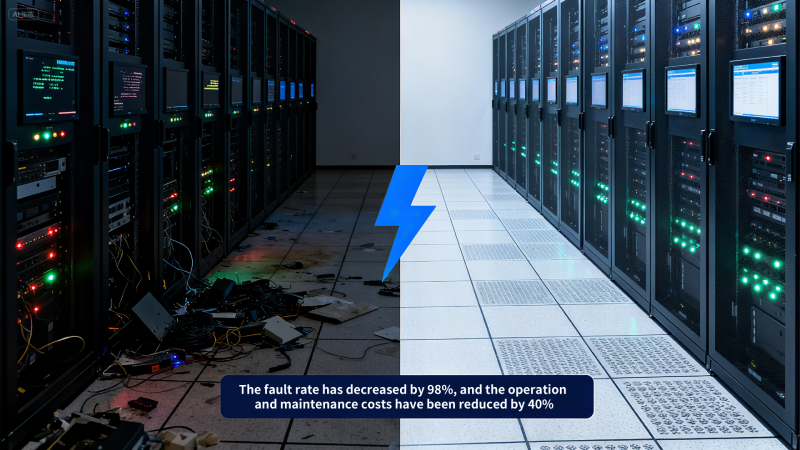
Real-World Fit: CWWIN’s Ventilated Flooring is installed in a regional telecom data center, reducing ESD-related downtime by 90% and cutting cooling costs by 15% (thanks to targeted air flow).
2. Electronics Manufacturing Plants
Assembly lines for smartphones, microchips, or aerospace components need zero-tolerance static control (body voltage ≤100V, per ANSI/ESD S20.20). CWWIN’s Anti-Static Floor Panel Series and SPC Flooring deliver because they:
• Create a permanent electrostatic network via PVC coatings, maintaining a resistance of 1.0×10⁶–1.0×10⁸Ω (ideal for dissipative control) and draining static as workers move between stations.
• Resist oil, coolant, and chemical spills—common in manufacturing environments—without degrading performance (tested to withstand 500+ cycles of spill exposure, per CWWIN’s quality standards).
• Pair with ESD carts and shoes to ensure static is drained from all moving objects, not just people—critical for preventing damage to components like microchips (which can be ruined by 50V+ static).
Real-World Fit: A consumer electronics factory using CWWIN’s Anti-Static Flooring reduced ESD component damage by 75% in its first year, meeting IPC-A-610’s “class 3” assembly standards for high-reliability electronics.
3. 5A Smart Offices & Financial Institutions
Banks, telecom headquarters, and intelligent offices need to protect sensitive IT infrastructure (trading systems, data servers) while maintaining a professional look. CWWIN’s OA Access Floor Panel Series and Ceramic Access Floor Series work here because they:
• Hide cables under raised flooring (3–6 inches of clearance), separating strong and weak currents to meet IEEE 802.3’s “Ethernet cabling” standards and simplify maintenance (no more tearing up carpets to fix wires).
• Feature stain-resistant, sleek ceramic surfaces that match high-end decor—critical for client-facing lobbies—and meet ASTM C1028’s “scratch resistance” standards (no visible wear even after 100,000+ foot traffic cycles).
• Support high foot traffic with steel cores, maintaining their resistance range (1.0×10⁶–1.0×10⁹Ω) for 10+ years—no need for re-coating or repairs.
Real-World Fit: CWWIN’s OA Access Flooring is installed in a major bank’s 5A office tower, streamlining wiring management for 2,000+ workstations and reducing static-related IT glitches by 80%.
4. Military & Aerospace Facilities
These industries follow strict MIL-STD-883H standards, which require ESD flooring to be fire-resistant, corrosion-proof, and durable. CWWIN’s Calcium Sulphate Floor Panel Series meets these needs by:
• Withstanding high temperatures (up to 300°C for short durations) and having a flame spread index of ≤20—exceeding MIL-STD-883H’s “flame spread ≤25” requirement for aerospace component testing.
• Featuring waterproof, galvanized steel casings that resist corrosion in humid or industrial environments (tested to withstand 1,000+ hours of salt spray, per ASTM B117).
• Providing a 15+ year lifespan that aligns with long-term military contracts—avoiding frequent replacements and ensuring consistent compliance over time.
Real-World Fit: CWWIN’s Calcium Sulphate Flooring is used in a military command center, complying with MIL-STD-883H and reducing ESD-related equipment failures by 95% during critical operations.
Why ESD Flooring Delivers Long-Term Value (Beyond “Stopping Static”)
When evaluating static control, it’s easy to focus on upfront costs—but ESD flooring stands out for its total value over time:
• Reduced downtime: No more halts due to ESD damage (e.g., a manufacturing line outage can cost $50,000+ per hour; a data center outage can cost $10,000+ per minute).
• Lower maintenance: Unlike mats or ionizers, CWWIN’s ESD flooring needs only occasional cleaning (with pH-neutral cleaners)—no calibration, filter replacements, or re-cabling.
• Future-proofing: It adapts to expanding spaces (e.g., adding a new assembly line) and works with new equipment (e.g., automated robots, heavier server racks) without needing upgrades.
• Compliance peace of mind: Meets global standards (ANSI/ESD S20.20, MIL-STD-883H, ISO 14644-1) to avoid penalties in regulated industries (e.g., $10,000+ fines for non-compliance in aerospace manufacturing).