
U.S. Guide to Cementitious Raised Access Flooring: ANSI Compliance, LEED Alignment & FAQs
- Addtime: 2025-10-30 / View: 202
In the U.S. building construction, data centre, and critical infrastructure sectors, cementitious raised access flooring systems serve as a foundational component for meeting strict operational efficiency, safety, and regulatory requirements. Engineered with inorganic composites—typically silicate, inorganic fibers, mineral fibers, and quartz sand formed under high pressure—these systems, developed by CWWIN Floors (a provider with deep expertise in inorganic flooring, including its flagship Cement Floor Panel Series), draw on Korean-derived technology optimized for global adaptability.
Part of CWWIN’s broader portfolio that includes anti-static floors, OA access floors, and calcium sulphate floors, this cementitious solution addresses key U.S. market priorities, from environmental sustainability to fire safety compliance. This article explores how this flooring aligns with U.S. standards, application-specific needs, and industry best practices, providing actionable insights for specifiers, contractors, and end-users.

Core Attributes of High-Performance Cementitious Raised Flooring
CWWIN’s Cement Floor Panel Series, as defined by the brand’s technical documentation, leverages advanced material science and manufacturing processes to deliver three defining benefits—now tailored to U.S. market demands:
1. Environmental Sustainability: Designed to meet CWWIN’s “green flooring” commitments, these panels are free of volatile organic compounds (VOCs), radiation, and non-biodegradable components. This aligns with the U.S. Green Building Council (USGBC) LEED® v4.1 criteria, making them ideal for LEED-certified data centres, corporate headquarters, and public facilities.
2. Modular Functionality: Integrated cable access holes— a signature design feature of CWWIN’s cement panel line—streamline underfloor cabling management for U.S. data centres and telecom facilities supporting high-performance computing (HPC) and 5G infrastructure. The modular design also enables rapid installation and reconfiguration, reducing project timelines for fast-track U.S. builds.
3. Structural Durability: Manufactured via high-pressure forming (a key process specified for CWWIN’s Cement Floor Panel Series), these panels exhibit exceptional compressive strength, meeting U.S. industry load standards such as ANSI/NAFCD 101.1-2021. This durability supports heavy equipment (server racks, HVAC units) common in U.S. facilities, while ensuring a 15+ year service life.
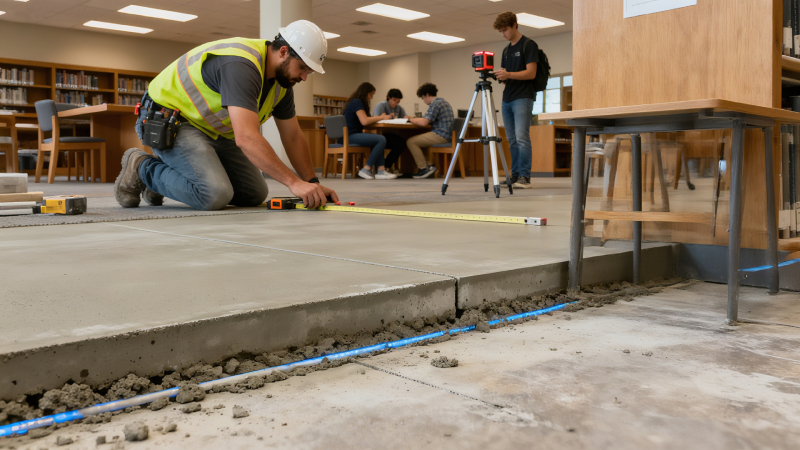
U.S. Application Scenarios: Aligned with Global Use Cases
This cementitious flooring, originally optimized by CWWIN for aerospace, military, and high-speed rail sectors, now meets U.S. standards for equivalent high-demand scenarios:
1. Data Centres & Telecom Facilities
The U.S. data centre market (valued at over $50 billion in 2024) requires flooring that balances cable management, airflow, and fire safety— needs addressed by CWWIN’s cement panel line:
• Supports underfloor airflow systems critical for cooling hyperscale data centres, with a smooth, non-porous surface that minimizes air leakage and improves energy efficiency.
• Eliminates extensive floor cuts with pre-integrated cable access holes, reducing installation time and the risk of structural damage.
2. Commercial & Corporate Buildings
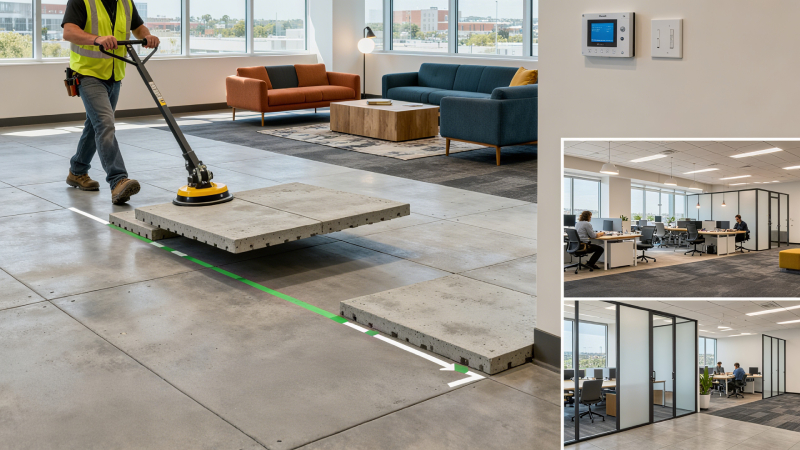
For U.S. LEED-certified offices and mixed-use developments, this eco-friendly cement flooring helps earn LEED points. Its modularity adapts to dynamic office layouts—from open-plan workspaces to private suites—supporting frequent reconfigurations without costly flooring overhauls.
3. Industrial & Manufacturing Facilities
U.S. automotive, aerospace, and electronics plants rely on flooring that withstands heavy loads (up to 1,000 lbs/sq ft for reinforced models) and chemical spills. The inorganic composition ensures resistance to oils, solvents, and industrial cleaning agents, meeting U.S. OSHA workplace safety standards and reducing maintenance costs.
U.S. Regulatory Compliance: Built on Quality Foundations
To meet U.S. codes, this cementitious flooring builds on CWWIN’s documented quality benchmarks, with additional compliance for U.S. standards— complemented by context on how these standards differ from global counterparts:
1. Surface Burning Characteristics (ASTM E84)
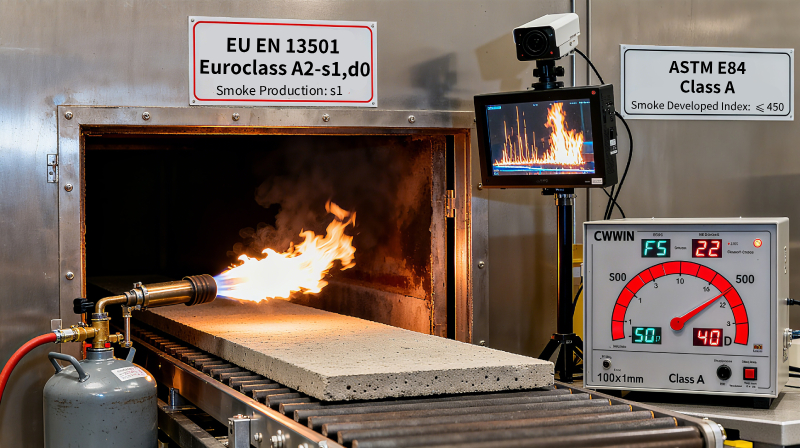
These panels achieve ASTM E84 Class A (FSI ≤ 25, SDI ≤ 450)— aligning with CWWIN’s emphasized “fire-retardant properties” for complementary calcium sulphate and cement floors. Unlike the EU’s EN 13501 (which uses a “Euroclass” system like A2-s1,d0 to rate fire performance), ASTM E84 places greater emphasis on quantifying smoke development (via SDI) and flame spread (via FSI), critical for U.S. code compliance in high-occupancy spaces.
2. Fire Resistance (ASTM E119)
For 1-hour/2-hour fire ratings (per IBC 2021), this panel assembly meets ASTM E119— extending CWWIN’s claims of “high-temperature resistance” to time-rated U.S. fire safety requirements. This differs from China’s GB/T 9978.1 (which tests fire resistance under similar temperature conditions but uses slightly different pressure metrics) and ensures compatibility with U.S. building inspectors’ standard evaluation criteria.
3. Anti-Static & Environmental Compliance
• Anti-Static: Meets ANSI/ESD S20.20 (surface resistance 10⁶–10¹⁰ Ω), matching the performance of CWWIN’s specialized anti-static floor series. Compared to the IEC 61340 (a global ESD standard), ANSI/ESD S20.20 includes more stringent requirements for facility-wide ESD control plans— a key distinction for U.S. electronics manufacturers.
• Environmental: Complies with U.S. EPA TSCA Title VI (restricting toxic chemicals in flooring) and California Proposition 65 (banning listed carcinogens). While the EU’s REACH regulation has similar chemical restriction goals, Proposition 65 requires more prominent consumer warnings for potential hazards— a unique U.S. compliance consideration.
Recommended Specification Language for U.S. Projects
To ensure alignment with CWWIN’s Cement Floor Panel Series, specifiers should include:
“Raised access flooring panels shall be CWWIN Floors’ Cement Floor Panel Series (or equivalent), composed of silicate, inorganic fibers, mineral fibers, and quartz sand formed under high pressure (per CWWIN’s documented manufacturing standards). Panels shall comply with:
1. ASTM E84: Class A (Flame Spread Index ≤ 25, Smoke-Developed Index ≤ 450);
2. ASTM E119: [1-hour/2-hour] fire rating (as required by project code);
3. ANSI/ESD S20.20: Surface resistance of 10⁶–10¹⁰ Ω for electronic/data centre applications;
4. LEED v4.1 compliance (zero VOCs, fully biodegradable), EPA TSCA Title VI, and California Proposition 65.
5. The manufacturer shall submit CWWIN’s certified test reports (matching the format of the brand’s documented product data) and product qualification documents. Panels shall include integrated cable access holes (per CWWIN’s design specifications) and meet ANSI/NAFCD 101.1-2021 load requirements for [target application, e.g., “data centre server rooms”].”
Frequently Asked Questions (FAQ)
Q1: What is the key difference between ASTM E84 and global fire performance standards for cementitious raised access flooring?
A1: ASTM E84 (U.S. standard) focuses on quantifying Flame Spread Index (FSI) and Smoke-Developed Index (SDI) to assign ratings like Class A (FSI ≤ 25, SDI ≤ 450). This differs from the EU’s EN 13501 (which uses “Euroclass” labels like A2-s1,d0 to rate fire, smoke, and droplet performance) and China’s GB/T 8624 (which emphasizes combustion heat release). For U.S. projects, ASTM E84 is critical for compliance with local building codes, especially in high-occupancy spaces.
Q2: Can cementitious raised access flooring support the load requirements of U.S. data centres?
A2: Yes, when manufactured to U.S. industry standards like ANSI/NAFCD 101.1-2021. Typical static load capacities range from 1,000–2,000 lbs/sq ft (sufficient for heavy server racks and HVAC equipment), while rolling load capacities (for maintenance carts) often reach 200–500 lbs. Reinforced models (with additional mineral fibers) can meet higher load demands for hyperscale data centres with dense equipment layouts.
Q3: How does U.S. anti-static compliance for flooring differ from global standards?
A3: The U.S. relies on ANSI/ESD S20.20, which includes strict requirements for facility-wide electrostatic discharge (ESD) control— such as testing protocols for flooring, equipment grounding, and employee training. This is more comprehensive than the global IEC 61340 standard (which focuses primarily on material resistance limits) and the EU’s EN 61340 (which aligns closely with IEC but has minor regional adjustments). For U.S. electronics facilities (e.g., chip manufacturing, data centres), ANSI/ESD S20.20 compliance is mandatory to protect sensitive equipment.
Q4: Are there regional environmental regulations in the U.S. that impact cementitious flooring selection?
A4: Yes, two key regulations stand out:
• EPA TSCA Title VI: Restricts the use of toxic chemicals (e.g., certain flame retardants) in flooring materials, ensuring compliance with federal environmental safety standards.
• California Proposition 65: Requires products containing listed carcinogens or reproductive toxins to include prominent warnings, even if they meet federal standards. This makes it a critical consideration for projects in California or for clients prioritizing strict chemical safety.
Q5: Is cementitious raised access flooring compatible with LEED-certified projects in the U.S.?
A5: Yes, when formulated to be zero-VOC, non-toxic, and fully biodegradable. Such flooring aligns with LEED v4.1 credits for “Indoor Environmental Quality” (reducing air pollutants) and “Sustainable Sites” (minimizing environmental impact). Its long service life (15+ years) also supports LEED credits for “Durable Building Materials,” making it a common choice for U.S. LEED-certified offices, data centres, and public facilities.
CWWIN’s Cement Floor Panel Series— rooted in the brand’s inorganic flooring expertise and global infrastructure experience— has emerged as a compliant, high-performance solution for the U.S. market. By retaining core attributes (inorganic composition, modular design, sustainability) and adding U.S. standard validation (with clear distinctions from global counterparts), CWWIN bridges the brand’s proven performance in aerospace, military, and high-speed rail sectors to U.S. data centres, commercial buildings, and industrial facilities.
Key considerations for U.S. specifiers:
• Verify CWWIN’s certified test reports (matching the brand’s documented data formats) for ASTM and ANSI compliance, noting how these standards differ from global alternatives.
• Explore CWWIN’s complementary flooring lines (anti-static, calcium sulphate) for integrated project needs, where applicable.
• Align with CWWIN’s sustainability commitments to meet LEED and corporate ESG goals.
As the U.S. invests in infrastructure modernization, CWWIN’s cementitious raised access flooring— backed by the brand’s proven technology and global adaptability— stands as a reliable choice for high-performance facilities.