
How Much Weight Can Anti-Static Raised Floors Hold? Data Center Load-Bearing Guide
- Addtime: 2025-09-29 / View: 427
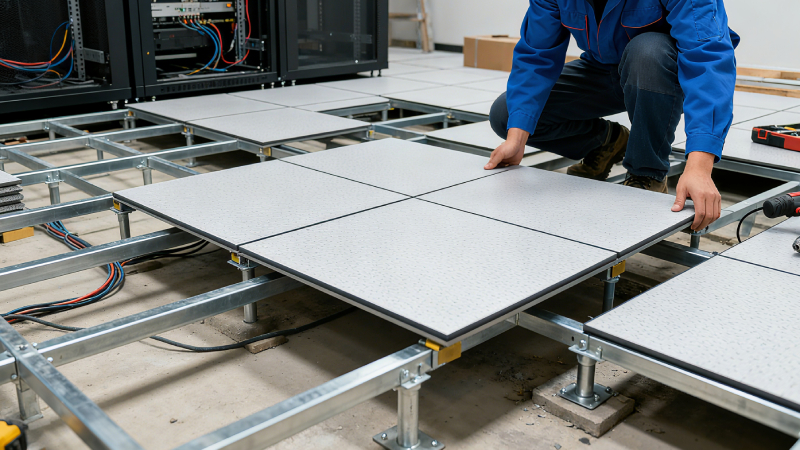
In data centers—where racks of servers, cooling units, and heavy network equipment form the backbone of operations—flooring isn’t just a surface layer. It’s a critical structural component that must support extreme weights, resist static damage, and accommodate underfloor infrastructure (cables, airflow systems).
Among the many flooring options, anti-static raised floor panels stand out for their specialized design—but how do their load-bearing capacities stack up against other common data center flooring systems? Below, we break down key comparisons, address real-world use cases, and help you align your choice with your data center’s unique needs.

First: Why Load-Bearing Capacity Is Non-Negotiable for Data Centers
Before diving into comparisons, it’s essential to clarify why load capacity matters for data center operations:
• A single fully equipped server rack can weigh 800–1,500 lbs (approximately 363–680 kg), and dense hyperscale data centers may house 100+ such racks per room.
• Flooring must handle dynamic loads too—including equipment installation, maintenance carts, or technician traffic—without cracking, shifting, or losing structural integrity.
• Underfloor spaces (critical for cable management and cold-air distribution in modern data centers) add extra demands: the flooring system must bear its own weight, the equipment above, and maintain stability for underfloor components.
For context, industry standards like CISCA (U.S.) and BS EN 12825 (EU) typically require data center flooring to support a minimum concentrated load of 2,940 N (approximately 662 lbs) and a uniform load of 12.5 kN/m² (approximately 261 lbs/ft²) for heavy-duty use. Now, let’s compare how anti-static raised floors measure up to alternative systems.
1.Anti-Static Raised Floor Panels vs. Traditional Solid Flooring (Concrete, Tile)
Traditional solid flooring—such as polished concrete or ceramic tile—is common in non-specialized spaces, but it falls short in data centers, especially for load-bearing and functionality.
|
Aspect
|
Anti-Static Raised Floor Panels
|
Traditional Solid Flooring (Concrete/Tile)
|
|
Load-Bearing Range
|
2,940 N–13,340 N (approximately 662 lbs–3,000 lbs) concentrated load; 12.5 kN/m²–46 kN/m² (approximately 261 lbs/ft²–961 lbs/ft²) uniform load (varies by material: steel-cementitious, calcium sulphate).
|
Concrete: ~4,450 N (approximately 1,000 lbs) concentrated load; 24 kN/m² (approximately 501 lbs/ft²) uniform load. Ceramic tile: ~2,225 N (approximately 500 lbs) concentrated load (prone to cracking under heavy racks).
|
|
Key Limitation
|
None for data center needs (high-grade panels meet military/industrial load standards, e.g., CWWIN Floor’s steel-cementitious panels exceed 13,340 N concentrated load).
|
Concrete can’t support underfloor infrastructure without costly retrofitting; tile cracks under dynamic loads (e.g., moving server racks).
|
|
Data Center Fit
|
Ideal: Supports heavy racks, accommodates underfloor cooling/cables, and prevents ESD (electrostatic discharge) damage.
|
Poor: Only suitable for low-density data centers with no underfloor needs (rare in modern operations).
|
Real-World Example: A hyperscale data center with 120 server racks (each 1,200 lbs/approximately 544 kg) would require flooring that handles 1,200 lbs per rack footprint. Anti-static steel-cementitious raised floors (like CWWIN’s SCS series) easily meet this, while ceramic tile would crack within 6 months of installation—and concrete would require tearing up the floor to add underfloor cables later.
2.Anti-Static Raised Floor Panels vs. Standard Raised Floors (Non-Anti-Static)
Standard raised floors (e.g., basic steel or wood-core) are used in offices or retail spaces, but they lack the static protection and load strength needed for data centers.
|
Aspect
|
Anti-Static Raised Floor Panels
|
Standard Raised Floors (Non-Anti-Static)
|
|
Load-Bearing Range
|
2,940 N–13,340 N (approximately 662 lbs–3,000 lbs) concentrated load; 12.5 kN/m²–46 kN/m² (approximately 261 lbs/ft²–961 lbs/ft²) uniform load.
|
Steel-core: ~2,225 N (approximately 500 lbs) concentrated load; 9.7 kN/m² (approximately 202 lbs/ft²) uniform load. Wood-core: ~1,780 N (approximately 400 lbs) concentrated load (warps under data center humidity).
|
|
Unique Advantage
|
Integrates anti-static coatings (PVC, HPL) or conductive materials to meet ANSI/ESD S20.20 standards—critical for preventing server short-circuits. CWWIN’s panels, for example, use permanent anti-static PVC layers that don’t degrade over time.
|
No anti-static protection—static buildup can cause $1M+ in equipment damage (a major risk for data centers).
|
|
Data Center Fit
|
Essential: Combines load capacity with ESD safety.
|
Risky: Fails static tests; insufficient load for dense server deployments.
|
Cost Note: While anti-static raised floors cost 15–20% more upfront than standard raised floors, they eliminate ESD-related downtime (average cost: $500,000 per hour for data centers). For example, CWWIN’s calcium sulphate anti-static panels reduce long-term costs by 30% compared to standard floors, thanks to their 15+ year lifespan and low maintenance needs.
3.Anti-Static Raised Floor Panels vs. Modular Flooring Tiles
Modular flooring tiles (e.g., SPC/WPC) are trendy for offices, but they’re not engineered for data center loads or static protection.
|
Aspect
|
Anti-Static Raised Floor Panels
|
Modular Flooring Tiles (SPC/WPC)
|
|
Load-Bearing Range
|
2,940 N–13,340 N (approximately 662 lbs–3,000 lbs) concentrated load; 12.5 kN/m²–46 kN/m² (approximately 261 lbs/ft²–961 lbs/ft²) uniform load.
|
~1,335 N (approximately 300 lbs) concentrated load; 7.2 kN/m² (approximately 150 lbs/ft²) uniform load (buckles under server racks).
|
|
Static Protection
|
Permanent anti-static properties (tested to ANSI/ESD S20.20). CWWIN’s ceramic-coated steel panels, for instance, maintain a surface resistance of 10⁶–10⁹ ohms—ideal for sensitive server equipment.
|
No anti-static features—static buildup is common, even in low-humidity data centers.
|
|
Data Center Fit
|
Perfect for all densities (edge, enterprise, hyperscale).
|
Only suitable for small edge data centers with 1–2 lightweight racks (not recommended for critical operations).
|
Which Anti-Static Raised Floor Material Offers the Best Load Capacity?
Within anti-static raised floors, material choice impacts load-bearing strength—here’s how the top options (all available from CWWIN Floor) compare for data centers:
|
Material
|
Concentrated Load
|
Uniform Load
|
Best For
|
|
Steel-Cementitious
|
Up to 13,340 N (approximately 3,000 lbs)
|
Up to 66.9 kN/m² (approximately 1,397 lbs/ft²)
|
Hyperscale data centers, military facilities (supports heavy cooling units and backup generators). CWWIN’s SCS series is certified for military-grade load requirements.
|
|
Calcium Sulphate
|
Up to 8,890 N (approximately 2,000 lbs)
|
Up to 44.5 kN/m² (approximately 930 lbs/ft²)
|
Enterprise data centers, bank server rooms (balances load capacity with acoustic performance—reduces equipment noise by 15–20%).
|
|
Ceramic-Coated Steel
|
Up to 6,675 N (approximately 1,500 lbs)
|
Up to 34.5 kN/m² (approximately 721 lbs/ft²)
|
Cleanrooms, lab data centers (resists chemicals, easy to sanitize, and supports medium-density server racks).
|
How to Choose the Right Load Capacity for Your Data Center
Follow these steps to avoid overpaying or under-sizing your flooring (CWWIN’s team can assist with custom calculations):
1.Calculate Your Maximum Load: Multiply the weight of your heaviest equipment (e.g., 1,500 lbs/approximately 680 kg server rack) by 1.5 (safety factor) to get your required concentrated load (in this case, 2,250 lbs/approximately 10,000 N).
2.Match to Panel Grade: For a 2,250 lbs requirement, choose a steel-cementitious SCS-1250B panel or calcium sulphate FS-1000 panel (both from CWWIN).
3.Plan for Future Growth: If you’ll add racks in 2–3 years, select a panel with 20% extra load capacity (e.g., CWWIN’s SCS-1500B instead of SCS-1250B) to avoid costly replacements.
Final Verdict: Anti-Static Raised Floors Are the Data Center Gold Standard
For data centers, anti-static raised floor panels outperform all other flooring systems in load-bearing capacity, static protection, and adaptability to underfloor infrastructure. While alternatives like concrete or modular tiles may cost less upfront, they lead to higher long-term costs (downtime, equipment damage, retrofits).
Whether you’re building a small edge data center or a large hyperscale facility, investing in high-grade anti-static raised floors—like those from CWWIN Floor—ensures your infrastructure is safe, stable, and scalable. CWWIN’s panels meet global standards (CISCA, BS EN 12825, ANSI/ESD S20.20) and are tailored to data center needs, from military-grade load capacity to low-maintenance anti-static coatings.
For personalized recommendations on panel grades, installation, or load calculations, contact CWWIN Floor’s data center flooring experts today—we’ll help you find a solution that aligns with your current needs and future goals.